ClimUP Newsletter May 2026
|
Curious how we can make our campus and daily life a little greener and more future-friendly?
Find inspiration here that leaves you wanting more, and knowledge that turns action into change. Together on the path to a sustainable, climate-friendly future.
|
Sustainability Strategy Published
The university's sustainability strategy was already adopted by the relevant committees in the summer and published at the end of November. The strategy understands sustainability as a central transformation task and is based on the Whole Institution Approach. It includes all areas – from research, teaching, and knowledge transfer to governance and campus operations. In its implementation, the strategy follows the priority model: ecological sustainability forms the central reference point, while social and economic dimensions are consciously considered. Infrastructural and construction measures include the further expansion of renewable energy on campus and the introduction of the EMAS environmental management system. The strategy also aims to anchor the central goal of sustainability in research, teaching, and knowledge transfer. Special thanks go to the two main authors, Vice President Prof. Dr. Werner Gamerith and former managing director of the Sustainability Hub, Stefan Schröder.
You can find the sustainability strategy here: https://www.uni-passau.de/en/sustainability/sustainable-campus/governance/sustainability-strategy
|
Dr. Stefanie Wehner, Vice President Prof. Dr. Werner Gamerith and President Prof. Dr. Ulrich Bartosch present the sustainability strategy
|
New Responsibilities in the Area of Sustainability
Since 1 April 2026, Vice-President Prof. Dr. Dr. h. c. Harald Kosch has been responsible for the Sustainability portfolio in addition to the Academic Infrastructure/IT portfolio. Prof. Dr. Werner Gamerith has been appointed Sustainability Officer by the University Executive with immediate effect. In this role, he oversees the areas of ‘Sustainable Campus’ and ‘Education for Sustainable Development (ESD)’ and continues to actively support the University in its efforts towards sustainability and climate protection.
|
Working together as a team for greater sustainability: Prof. Dr. Dr. h. c. Harald Kosch, Vice-President for Academic Infrastructure/IT and Sustainability, and Prof. Dr. Werner Gamerith, Sustainability Officer for the University Executive, are working together to promote a sustainable University of Passau.
|
|
What we are doing on campus
|
PV Systems on Campus Commissioned
After about six years of planning and implementation, the University of Passau has successfully commissioned a nearly comprehensive photovoltaic system on its campus. The largest energy project in the university's history has a total output of 2,600 kWp and extends over 14 building roof areas and 13 technical sites.
The system was made possible by funding from the Free State of Bavaria and is connected to the power grid of Passau's municipal utilities via the university's own medium-voltage network. A newly installed electricity storage unit with a capacity of 700 kWh increases self-consumption and reduces dependence on external electricity.
Particular challenges included compliance with strict technical standards, recalculations of structural loads (due to changed snow load requirements), and a design that respects heritage protection. The installation was carried out almost without disruption during ongoing university operations.
The additional capacities will enable more resource-efficient cooling generation, optimized cooling concepts for the cafeteria, and supplementary heating solutions in the future. University President Prof. Schumann and his predecessor Prof. Bartosch emphasize the importance of the project for an autonomous, resilient, and sustainable energy supply for the university.
|
Commissioning of the PV system at the University of Passau; (from left) former President Prof. Dr. Ulrich Bartosch, Josef Köberl (Head of Facility Management, University of Passau), Mr. Steinhofer (ELMA planning office), President Prof. Dr. Jan H. Schumann, Mr. Englmaier (Solar Pur AG), Konrad Binder (project manager), Mr. Rimbeck (Wirth GmbH), Prof. Dr. Werner Gamerith; Photo: University of Passau/Schwarz.
|
Trees on Campus
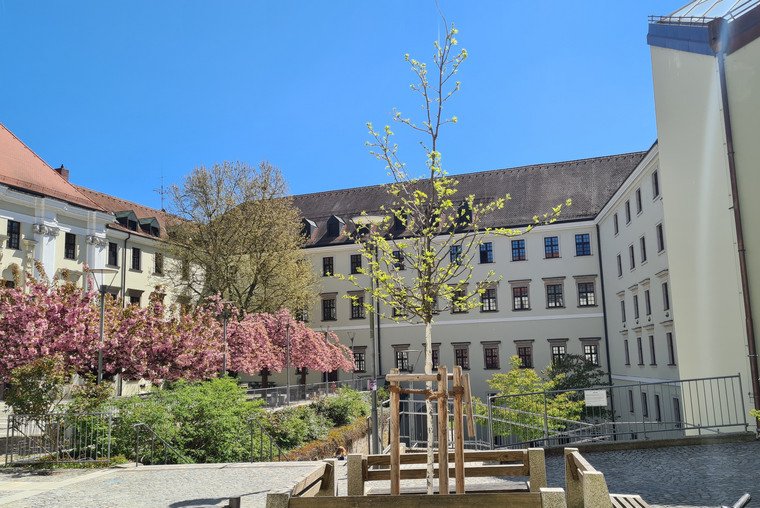
We are delighted about the new tree planted at the entrance of the Nikolakloster, above the archway. It replaces the plane tree that was uprooted by a storm in 2024 and had to be felled. Unfortunately, we also had to say goodbye to a beautiful old poplar tree between the ITZ and IM buildings. Large branches had broken off from this tree several times.
Traffic safety could no longer be guaranteed. Therefore, the difficult decision was made to remove the tree. At least space has been created so that the surrounding trees can now continue to thrive.
|
New tree at the Nikolakloster: It replaces the plane tree lost to a storm in 2024 and once again sets a green accent at the entrance.
|
Natural Flowering Meadows
Since April 2025, the University of Passau has been transforming over 6,000 square meters of weekly mown lawn areas into species-rich, natural meadows. Instead of monotonous green, buttercups, yarrow, carnations, and many other wild plants now bloom there – an important habitat for wild bees, beetles, and other insects. By reducing mowing (only two to three times a year), the plants can bloom fully and set seed, improving soil, water balance, and climate resilience.
An assessment with the Passau Landscape Management Association found that the natural plant population is already so species-rich that expensive foreign seeds are initially not needed. Instead, self-propagation is encouraged by leaving the mown material lying for a few days.
From the summer semester 2026, the project will be scientifically accompanied (Prof. Dr. Schmitt): regular vegetation mapping, soil samples, and insect counts are planned. This allows students to conduct hands-on research – a gain for teaching, biodiversity, and sustainable campus development.
|
Map of the planned natural areas to increase biodiversity
|
|
What we are doing for the climate
|
Tree Planting in Northern Ghana: 1,000 Trees for the Climate
Research activities in an international context are associated with greenhouse gas emissions. While flights are still compensated for by the Free State of Bavaria, a research group from the University of Passau's Geography Department went one step further: one result of the research in rural Ghana was the need for reforestation to improve the microclimate and provide fruits and nuts to improve the population's food situation. Together with the inhabitants of the five villages studied, a volunteer agroforestry expert, and private donations, the Passau team helped plant nearly 1,000 trees, including mango and cashew trees. Some of the trees are on school grounds or in public spaces so that they can be cared for and used collectively. Each year, these trees potentially sequester 15-20 tonnes of carbon dioxide. Over the entire project period of 3.5 years, the Passau team generated approximately 30 tonnes of carbon dioxide emissions related to mobility. In addition, a good and lasting basis for cooperation with the Global South has been established.
|
Climate protection in Ghana: Dr. Christian Ungruhe and Ghanaian partners plant a young tree on barren soil.
|
New Urban Gardening Group at the University of Passau starting SS 2026
In the summer semester of 2026, a new urban gardening group was founded at the University of Passau. It takes care of the various urban gardening stations on campus and warmly invites students and staff to join in.
The group's goal is to maintain, further develop, and make accessible the existing green oases – including the student garden at the WiWi building, the raised beds at Kulturtransport, and the campus field of the CampusAckerdemie. The group is guided by the Ackercoach of the CampusAckerdemie and the university's Climate Protection Unit.
Interested students and staff can contact Dr. Stefanie Wehner from the Climate Protection Unit at any time. She will be happy to provide information about current dates and opportunities for involvement. The University of Passau has been active in urban gardening since 2021.
With the student garden, the CampusAckerdemie, and the beds of Kulturtransport e.V., a lively, sustainable campus green space is emerging piece by piece, fostering community and inviting hands-on learning.
Anyone who feels like gardening, fresh herbs and vegetables, or simply being part of a colourful community is very welcome – whether with or without prior experience.
|
Project Funding
National Climate Initiative
With the National Climate Initiative, the German government has been initiating and funding numerous projects since 2008 that contribute to reducing greenhouse gas emissions. Its programmes and projects cover a broad spectrum of climate protection activities: from the development of long-term strategies to concrete assistance and investment funding measures. This diversity guarantees good ideas. The National Climate Initiative helps to anchor climate protection locally. It benefits consumers as well as companies, municipalities, and educational institutions.
|
V.i.S.d.P.: University of Passau, Innstraße 41, 94032 Passau
Tel.: 0851/509-2022
Contact for questions: nachhaltigkeit@uni-passau.de
|
|