ClimUP Newsletter – October 2026
|
Curious to see how we can make the campus and our everyday lives a little greener and more future-facing? In the October issue you can look forward to good news from the international sustainability comparison, new opportunities in teaching and research, and concrete ideas for how we can save energy and resources together.
|
GreenMetric Ranking 2026: University of Passau ranked among the top ten percent worldwide for the first time
The University of Passau has achieved a notable success in the current UI GreenMetric Ranking: with position 187 out of 2,016 participating higher education institutions, it is ranked among the top ten percent worldwide for the first time. In the previous year, the University had ranked 231st among 1,745 institutions. The improvement is all the more remarkable given that the number of participating institutions has once again risen significantly.
Best result in waste management
The ranking assesses the sustainability performance of higher education institutions across seven categories in 2026. The area of "Governance & Digitalization" has been added as a new category. In the waste management category ("Waste"), the University of Passau achieves the maximum possible score of 1,700 points. It also achieves very good results in the areas of energy and climate change, water, and mobility and transport.
"The fact that the University of Passau is a special place associated with sustainability in the broadest sense is reflected in this excellent result – the best since the University began participating regularly and successfully in the comparison in 2021," highlights Prof. Werner Gamerith, the University of Passau's Sustainability Officer. "The pleasing result also stands for the 'spirit' of everyone at the University, staff and students alike, who contributed to its success and for whom a sustainable campus is a matter of great importance."
Already when the campus was being planned in the 1970s and 1980s, the aspiration of creating a future-oriented and sustainable higher education site played a role. More recent developments include the commissioning of a comprehensive photovoltaic system as well as measures to promote biodiversity and urban gardening.
The results show what is possible when many people work together towards a more sustainable campus.
About the ranking:
https://uigreenmetric.com/rankings/university/overall-rankings-2026
|
From November: Green Office in the Nikolakloster
In November, the Green Office will open in room NK 504, initially on every Thursday. It will be run by our student staff members Elisabeth and Annabelle and by Lukas, who is completing a voluntary ecological year (FÖJ) with us.
The Green Office is a point of contact for questions and suggestions, and a space for networking and for working on concrete projects, whether together or on your own. In the coming weeks and months, we will start organising the Public Climate School, the Green Careers project and the preparations for the Fair-Trade University.
Come and see us!
Further information (opening hours and activities) is available here on the website.
|
Student project funding for sustainability projects
Do you or your student society have an idea that you would like to put into practice on campus?
We have the funding! Apply now to the Student Project Funding Committee!
As students, a project group or a student society, you can receive up to €2,500 in funding for your project.
The funding is available not only for projects with a sustainability focus, but also for other projects. Further information can be found here.
If you have any questions, please feel free to contact us at nachhaltigkeit@uni-passau.de.
|
ADFC Bicycle Climate Test 2026
How easy is it to cycle in the university town of Passau? Where are the safe cycle paths, and where is there room for improvement? In the ADFC Cycling Climate Test 2026, you can share your experiences and ideas until 30 November 2026.
Whether you cycle every day, occasionally, or so far prefer to use other means of transport, your assessment counts! In around ten minutes, you can rate how cycle-friendly Passau is. The results show where the city already offers good conditions for cyclists and where policy makers and transport planners should make improvements.
Take part in the ADFC Cycling Climate Test here to make cycling in Passau safer and more attractive!
|
Global Sustainability Challenge 2026–27: develop your idea for a more sustainable world
Do you have an idea for making better use of energy, for how cities can cope with heat, or for how the supply of water and food can be secured even in times of climate crises? Then the Global Sustainability Challenge could be just the thing for you.
The international competition brings together students who want to develop, test and present solutions to concrete sustainability problems. Students from all disciplines are eligible to take part. Teams consist of one to six people; interdisciplinary teams and groups with members from different higher education institutions are also welcome. There is no participation fee.
For the 2026–27 season, there are two thematic areas: - Sustainable Energy: renewable energy, energy storage, energy efficiency and resilient electricity supply, for example.
- Adaptation & Resilience: solutions for adapting to the impacts of climate change, particularly in the areas of water, food security and protection against heat.
The first phase involves forming a team, identifying a problem and developing a viable concept. Ideas are then developed and tested into prototypes. The best teams can qualify for the global final through regional competitions. Accompanying mentoring offers and workshops support the participants.
Important for those who decide at short notice: 22 November 2026 is given as the deadline for the qualification round. Anyone wishing to take part should find out in good time and check the submission requirements on the official competition platform.
Further information and participation: https://www.globalsustainabilitychallenge.org/
|
Saving energy together: heating with the window open?
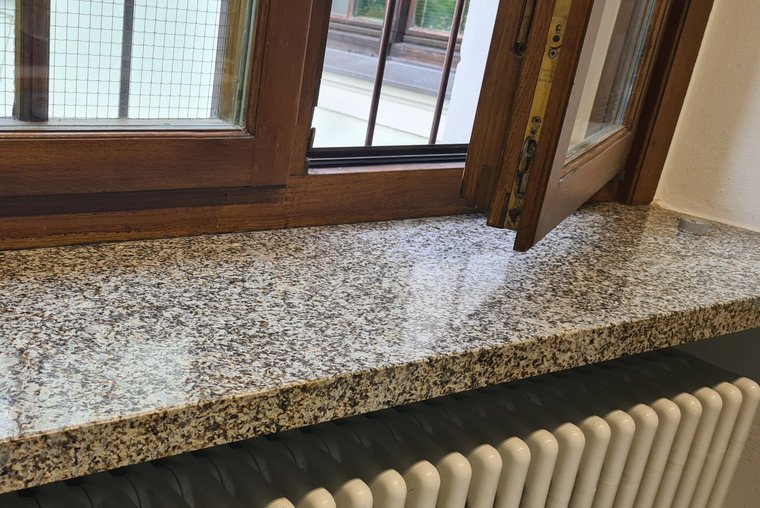
The heating season is beginning – and with it a good opportunity to keep an eye on our energy consumption. Perhaps you have already noticed it too: in some washrooms, the heating is running at full blast while the windows are permanently tilted open. Not only is this uncomfortable (freezing cold air), it also wastes a great deal of energy – we are literally heating straight out of the window.
What can we do? - Ventilate briefly and purposefully: where the windows allow it, short bursts of shock ventilation are generally more sensible than windows left permanently tilted open.
- Close the windows after ventilating: even a quick check helps avoid unnecessary heat loss.
- Report problems: if a window does not close properly or is difficult to operate, it helps to report this to the responsible building administration or to Facilities Management. In this way, technical causes can be investigated.
- Stay attentive together: anyone who notices an unnecessarily open window can close it, provided this can be done without any problems.
Especially during the heating season, many small gestures make a difference. Thank you very much for taking part!
|
|
From teaching and research
|
Public lecture series: "Habitability in the Global South"
How can our planet remain habitable in times of global crises? This is the question addressed by the interdisciplinary public sustainability lecture series (Ringvorlesung "Nachhaltigkeit") at the University of Passau in the winter semester 2026/27. Under the title "Habitability in the Global South", the series sheds light on the challenges and scope for action regarding the habitability of our planet, with a particular focus on perspectives from the Global South.
The lectures take place on Wednesdays from 18:00 to 20:00 (c.t.); the venue will be announced at a later date. The events are open to the public; no registration is required. The lectures are held in English. If you attend all events, a certificate of attendance can be issued (registration via StudIP required).
Provisional programme: - 4 November 2026: Prof. Wendy Harcourt, University of Rotterdam
- 18 November 2026: Dr Tina Beuchelt, University of Bonn
- 2 December 2026: Dr Ali Emre Benli, University of Vienna
- 16 December 2026: Dr Isabella Radhuber, University of Vienna
- 13 January 2027: tbc
- 27 January 2027: Prof. Sule Eyga, University of Duisburg-Essen
The series is an invitation to discuss together the challenges and opportunities of habitability and sustainability. The original page offers further information and background on the individual lectures. All those interested are warmly invited – we look forward to seeing you and to an exciting discussion!
|
New extension subject for teacher training: Education for Sustainable Development
How can schools help young people to actively shape the challenges of a changing world? From the winter semester 2026/27, the University of Passau is offering the new extension subject "Education for Sustainable Development" (ESD).
The offer is aimed at teacher training students of all school types as well as teachers already working in the school system. The programme comprises 45 ECTS credits in six modules and concludes with the First State Examination. It can also be completed alongside a job (part-time).
The curriculum includes, among other things, the fundamentals of ESD, ecological, social and economic challenges from local to global level, as well as didactic methods that can be used to promote sustainable thinking and action in the classroom.
The aim is to support prospective and practising teachers in bringing future topics into school and the classroom in a well-founded, multi-perspective and practice-oriented manner.
Further information on the extension subject: https://www.zlf.uni-passau.de/studium/erweiterungsfaecher/erweiterungsfach-bne
|
Public Climate School
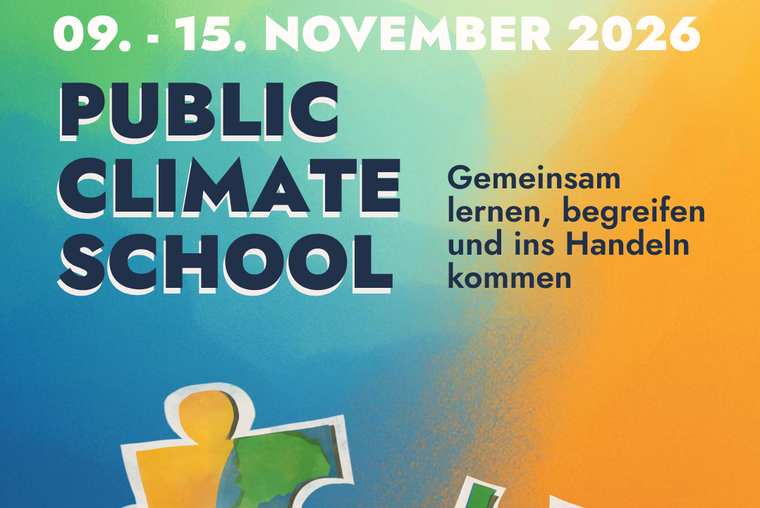
The Public Climate School (PCS) is a nationwide week of action during which courses and activities centred on climate education are opened up to the public. The aim is to convey scientifically sound knowledge about the climate crisis and to raise awareness of related issues. The PCS is open to everyone – not just students – and includes lectures, workshops and discussion sessions.
The Public Climate School 2026 will take place across Germany from 9 to 15 November 2026 – including here at the University of Passau; you can find the programme here.
Anyone interested is invited to join us! Whether as a participant, by organising a course, in a seminar or simply out of curiosity: help make the PCS at the University of Passau a powerful statement for climate education and social change.
Do you have a suitable event? Then please register your event at greenoffice@uni-passau.de – even at short notice. We’ll be happy to include it in our programme.
At this year’s BayZeN networking event, the keynote lecture by Prof. Dr Dirk Brockmann will be streamed live on the morning of Friday, 13 November 2026. The talk on complex networks and cooperation offers starting points for exploring how societal collaboration can succeed in tackling the climate crisis – and can be easily integrated as a supplementary activity in courses or PCS formats. The time and access details will be announced in due course.
|
The Campus Garden Crew’s Year in the Garden
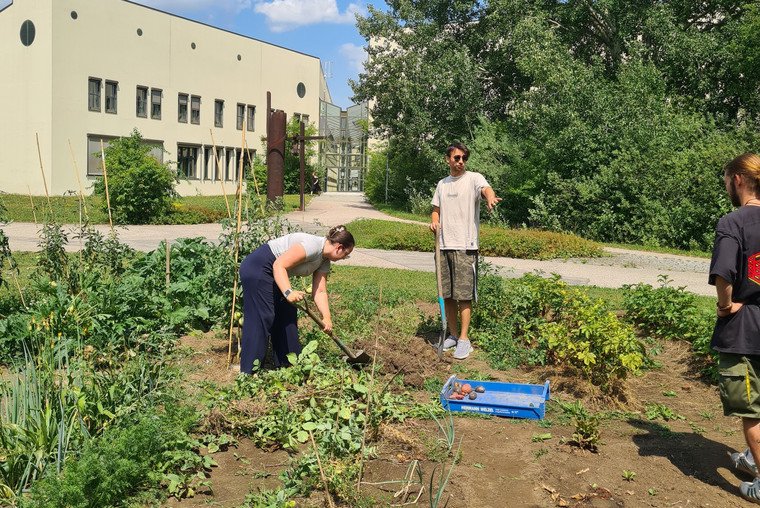
The gardening year is drawing to a close, and we can look back on a successful year: despite the drought and heat, we managed to bring in a bountiful harvest – tomatoes and aubergines in particular benefited from the warm weather. Our team managed to take turns watering the plants and keep the weeds at bay.
A particular highlight was the variety of tomato varieties we received from the Community-Supported Agriculture scheme in Unteröd and from one of our staff members. This meant we were able to harvest over 10 different varieties of tomato.
Various autumn and winter vegetables are still growing at the moment, and the season officially ends on 27 October – that’s when we’ll prepare the garden for winter and harvest the last of the vegetables together.
Further information about the gardening team is available on the website.
Would you like to join us? Sign up here.
We look forward to welcoming new members next year!
|
|
Organisation and Governance
|
The University of Passau takes stock of its involvement in BayZeN
How can higher education institutions learn from one another on climate protection and jointly develop effective measures? This is the question being addressed by the Baverian Centre for Higher Education and Sustainability (BayZeN), in which the University of Passau has been involved as one of eight partner universities since its foundation in 2023.
Over the past three years, the University has been particularly active in the area of university operations. It has regularly taken part in information events and supported six working groups on topics such as climate protection, operations, procurement and waste management, Green IT, as well as environmental management and greenhouse gas accounting.
During the University of Passau’s involvement, three working groups were established, which are set to continue even after the current coordination phase comes to an end. The results of this collaboration include a procurement and waste management guide, a catalogue of measures for Green IT, and climate protection strategies developed using the BayCalc tool.
This exchange demonstrates how important cross-university networks are for sharing experiences, further developing solutions and embedding sustainability in university operations in the long term.
|
Project Funding
National Climate Initiative
With the National Climate Initiative, the German government has been initiating and funding numerous projects since 2008 that contribute to reducing greenhouse gas emissions. Its programmes and projects cover a broad spectrum of climate protection activities: from the development of long-term strategies to concrete assistance and investment funding measures. This diversity guarantees good ideas. The National Climate Initiative helps to anchor climate protection locally. It benefits consumers as well as companies, municipalities, and educational institutions.
|
V.i.S.d.P.: University of Passau, Innstraße 41, 94032 Passau
Tel.: 0851/509-2022
Contact for questions: nachhaltigkeit@uni-passau.de
|
|