















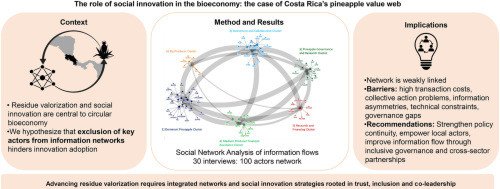
The article "The role of social innovation in the bioeconomy: The case of Costa Rica's pineapple value web" byGremary A. Aza-Mengoa, Karla Bajos-Arguello and Terese E. Venus was published in the Journal of Environmental Management.
Abstract
As the circular bioeconomy transition involves a change in current social practices to institutionalize a new paradigm, key actors within a network can facilitate the diffusion of innovation. To examine the role of social innovation in sustainable management of agricultural residues in the Global South, we focus on a case study of Costa Rica's pineapple value web. We mapped information flows, assessed the existing interventions valorizing residues, the barriers, motivations and roles of different type of actors. We use quantitative Social Network Analysis and Qualitative Content Analysis based on 30 semi-structured interviews with key stakeholders. We analyzed a network of 100 actors and our findings reveal weak network cohesion, inadequate information dissemination, critical barriers to innovation and misaligned motivations. The network reveals centralized power structures with low participation of large companies, and exclusion of start-ups and community actors. Compared to the Global North, we find that cooperatives and producer associations are key and trusted actors in the dissemination of information. Barriers to innovation an collaboration include high transaction costs (time, coordination, trust-building), collective action problems (driven by mistrust and cultural resistance), information asymmetries (knowledge gaps), technical constraints (logistics, machinery), and governance gaps (policy discontinuity and fragmented leadership). Overall, we recommend to strengthen leadership and policy continuity, empower local actors, improve information flow through inclusive governance, and foster cross-sector partnerships. Our findings are relevant for policy efforts to support circular bioeconomy in the Global South and deepen the understanding of social innovation within sustainability transitions.