

Diversity Day 2025
Nationwide day of activities on 27 May 2025
Our society is colourful and diverse. So is our university. That is why the University of Passau participates in the nationwide Diversity Day, which was initiated by the Charta der Vielfalt e.V. (Diversity Charter Association).
This year, the Science Slam Diversity was held for the third time.
Science Slam Diversity
What is a Science Slam?
A Science Slam offers a unique opportunity to present your own field of research or project to an audience in a lively and entertaining way within a short period of time. Creativity in the presentation is expressly encouraged – because science can also be fun!
All participants have 10 minutes to present their research topic and, above all, to win over the audience.
That's how diverse research is in Passau! With our Science Slam Diversity, we want to show the diversity of research at our university.
Programme Science Slam Diversity 2025
Enjoy the following exciting presentations:
- Julia Wiesmayr: Language you can see – sign language as part of linguistic diversity – This contribution presents the results of several research papers that provide an overview of sign language with interesting facts. (in German)
- Fiala Skander: I Saw the TV Glow (2024): Queer identity formation in and through media – The film ‘I Saw the TV Glow’ caused quite a stir in the trans* community on social media and brought tears to many eyes. This article examines the protagonists' search for identity and shows how the media can be a helpful guide when it comes to the question: ’Who am I really?’ (in German)
- Sarah Beyvers: Rage against the Machine: Video Games, Queer Play and Ludic Resistance – Video gamers often behave in ways that were neither intended nor anticipated by game designers. These activities are by no means automatically political – they are often carried out by players out of pure malice or a picaresque desire for disobedience and chaos. However, these other ways of playing can become practices of ludic resistance when players actively use them for political purposes. This article examines the processes that take place when these other ways of playing take on political significance.
- Nina Kunze: As a woman on the shoulders of medieval women in Passau – Medieval women in Passau remain extremely under-researched. This presentation introduces them and reports on research difficulties related to this topic. (in German)
- Dr Jonathan Rose: Painful Pleasure: Gay BDSM Erotica and the Politics of Diversity – Erotic narratives are more than just arousal – they reflect and reinforce cultural ideas about identity, power and desire. Pleasure is not just a matter of physical sensation, but can also be a site of negotiation, both between characters and with a broader discourse on (permissible) desire. This contribution critically examines the tropes represented in gay erotica and explores how gender expression, class, ability, or race shape these texts.
- Dr Vanessa Vollmann: The intersectional butterfly on hope and feathers – This contribution takes a critical look at Emily Dickinson's poem ‘Hope is the thing with feathers...’ and focuses in particular on power structures that affect women at the intersection of gender and women of colour at the intersection of race.
- Nina Riedler and August Krocker: Linguistics saves the world. By a woman to boot – This contribution analyses the science fiction film Arrival (Denis Villeneuve, 2016) from a gender perspective: it shows how men, who are stereotypically seen as experts and scientists, are replaced by a woman who not only explains how to communicate, but also ensures world peace and peaceful coexistence with aliens.
- Bettina Pflugbeil: Rollercoaster, deadlines, hyperfocus, everyday student life – chaos or superpower? – ADHD is much more than the cliché of a fidgety child – students are also affected and have to find their way through everyday student life full of deadlines, distractions and challenges. This presentation explores whether and how students can use creative strategies to overcome these obstacles or even turn them into strengths in order to master the balancing act between chaos and structure – with a good dose of humour and scientific background. (in German)
- Daniela Polzer: Tale as old as Time – Gender Roles in Disney’s Beauty and the Beast (2017) – This contribution examines gender concepts using the main character Belle as an example. The focus is on whether and how the character presents a progressive female role model, or why this is not the case. (in German)
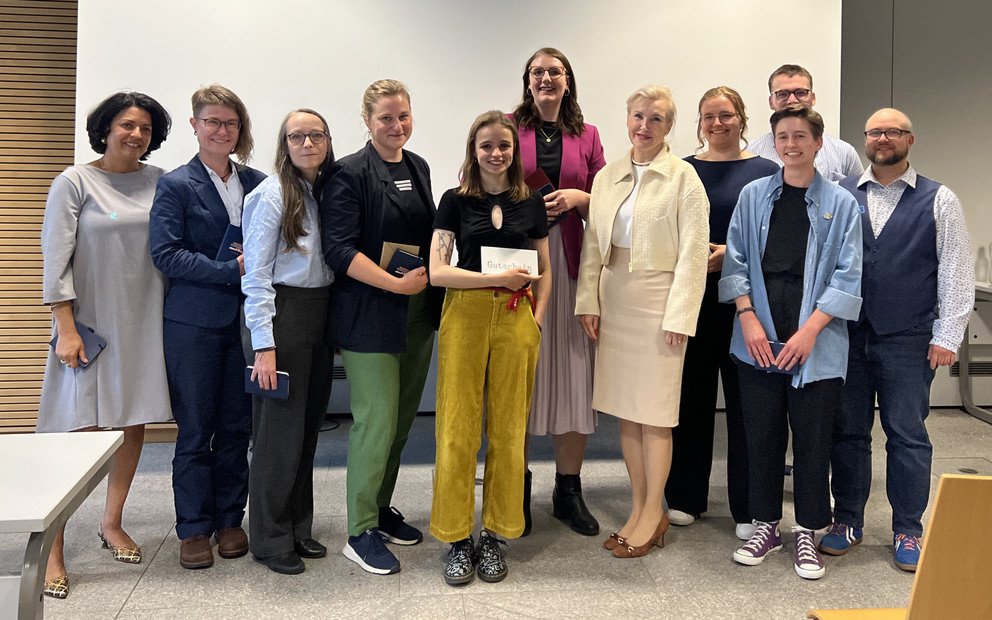
The Science Slam will be opened by Prof. Christina Hansen, Vice President for International Affairs and Diversity. Katrina Jordan will moderate the evening.
Congratulations & Thanks
We would like to congratulate all participants on their fantastic contributions, especially our winners:
- Sarah Beyvers
- Daniela Polzer
- Julia Wiesmayr
- Dr. Vanessa Vollmann and Nina Kunze
A big thank you also goes to the Alumni Club, Bücher Pustet, Kaffeewerk and Miri's Café for sponsoring the prizes.

 Share this page
