
The University of Passau is committed to the broad democratisation of scholarly practice in the spirit of Open Science. This includes open access to research findings and their dissemination through open educational resources (OER).
OER comprise teaching and learning materials of any kind and in any medium that are either in the public domain or published under an open licence. Such licences permit free access, use, adaptation, and redistribution by others with no or only minor restrictions. As a rule, the authors themselves determine which usage rights they grant and which they reserve.
On the basis of its OER Policy, the University of Passau supports its members in creating, using, and disseminating high-quality OER by providing information, training, and advisory services.

The OER policy was adopted by the university executive on 3 February 2026. You can view the full document here.
Open PolicyOpen Educational Resources (OER) are educational materials of any kind and in any medium that are licensed under an open licence. Such a licence allows free access, as well as free use, adaptation and redistribution by third parties, with no restrictions or only minor restrictions.
As a rule, the authors themselves determine which usage rights they grant and which they reserve. Open educational resources may range from individual items to entire books or complete courses. They can take any media format: curricula, course materials, textbooks, streaming videos, multimedia applications, and podcasts all qualify as OER provided they are published under an open licence.
Open Educational Resources can include individual materials, as well as books or entire courses. Any format is possible; the decisive criterion is the licence. Syllabuses, course materials, textbooks, streaming videos, multimedia applications, podcasts – all these resources are OER if they are published under an open licence, e.g.
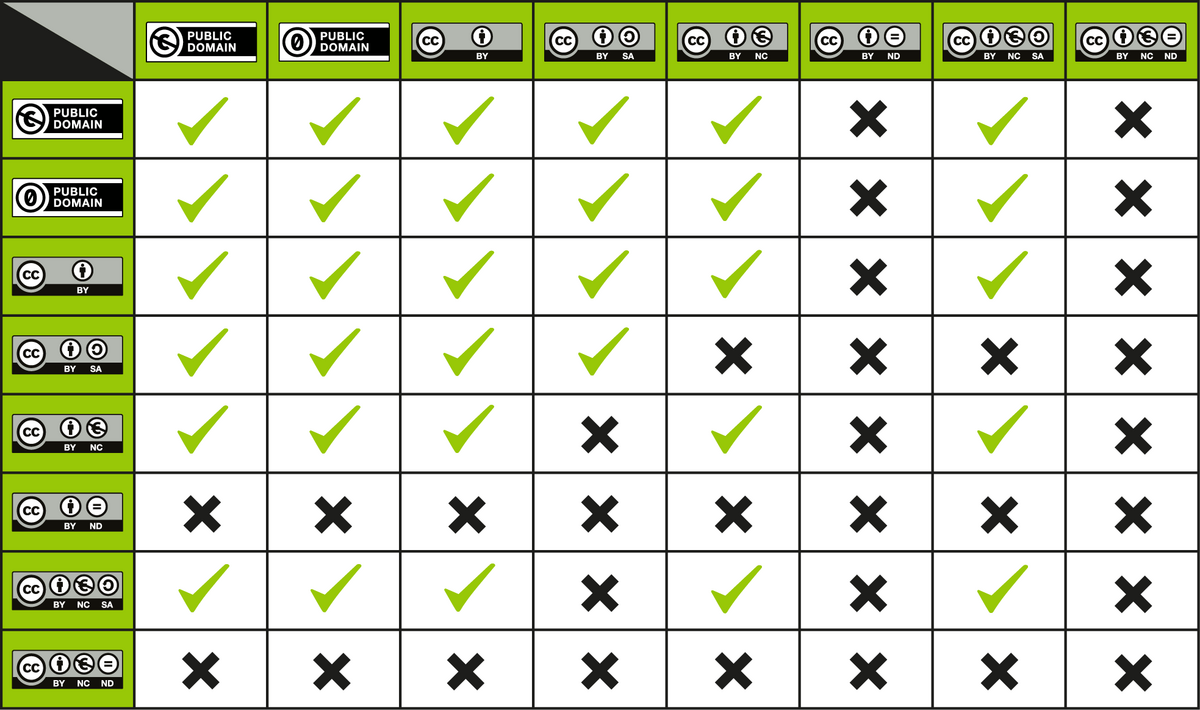
You can recognise OER by their open licences, usually Creative Commons (CC). Pay attention to the abbreviations, as these determine how you are permitted to use the material. Due to the requirements regarding openness in terms of commercial use and permission to adapt the material, only CC0, CC BY and CC BY-SA are considered OER. For free software, comparable licence types have been established (e.g. GNU, MIT), which serve as models for the CC licences.
OER facilitate access to open, high-quality education. To live up to this standard, critical reflection on the quality of educational materials is essential. A useful instrument in this context is the Instrument for Quality Assurance of OER (IQOer) developed by Müskens et al. (2022), which builds on an international survey of quality assurance tools conducted by Zawacki-Richter and Mayrberger (2017).
Resources and guidance for getting started:
When incorporating OER into your slides or learning management system (LMS), proper attribution is required. In the English-speaking OER community, the TASL rule (derived from Creative Commons best practice) serves as a helpful mnemonic:
It is also advisable to note any exceptions to the licence — for instance, the University of Passau logo on your slides is not covered by the open licence and should be marked accordingly.
To facilitate reuse, it is helpful to include a clear licensing notice directly on the material. This preserves the ability to extract OER from larger works and use them in a legally compliant manner.
A useful tool for generating licence notices is the OERhörnchen licence generator: https://oerhoernchen.de/bildungsteiler/

To search for OER, your best option is to use OER repositories and referatories. A repository is the physical storage location of digital files — similar to a library that owns and manages its own collection. A referatory functions as a directory or catalogue that points to materials stored elsewhere — similar to a search engine that directs users to books held in many different libraries.
The best starting point is OERsi (Open Educational Resources Search Index), the central search engine for OER in German-speaking higher education. It searches multiple repositories simultaneously.
Some German federal states operate their own portals, which are generally accessible nationwide. The University of Passau recommends the following repositories and reference collections::
If you would like to explore the topic at your own pace first, the OER Campus in Stud.IP offers an option for searching OER and for publishing your own materials as OER within the university.
Beyond the pedagogical design, copyright issues must be taken into account. Students are the authors of their own work and therefore decide for themselves whether, how, and under which licence their work is published. Publication as OER must be voluntary. Consequently, students must not face any disadvantages if they choose not to release their work under an open licence.
OER-Info: A specialist online platform providing comprehensive information on Open Educational Resources for the general public and professional audiences.
OER Course for Teacher Education: This DiLab learning resource introduces the fundamentals of OER, with a particular focus on teacher education at the University of Passau.
twillo: Offers a range of templates and guidelines related to OER.
OER FAQ: Answers to frequently asked questions about Open Educational Resources.
Copyright guidance: The updated and fully revised guide “Urheberrecht in der Wissenschaft” (Copyright in Academia) provides practical and accessible answers to common copyright questions related to teaching and research, including the use of third-party materials and the creation and publication of one's own copyrighted works.
On the page “Informationen zum Urheberrechtsgesetz“ (Information on Copyright Law), the University of Passau provides basic information on copyright in the higher education context, including frequently asked questions.
From a legal studies perspective: the website of the Chair of Private Law, especially Business Law and Digitalisation, offers numerous resources on copyright from a legal perspective, including a contribution on legal ambiguities surrounding Open Educational Resources.