The programme begins in April (summer semester).
The application period runs from 1 November to 15 January (for all applicants).
Please use our personalised, interactive guide to find out how to apply.
The decisive factor for the application process is not your nationality, but the country in which you obtained your relevant university degree.
Please use our personalised, interactive guide to find out how to apply and which documents you need.
Typical required documents include (depending on your prior education):
and – if applicable – certified translations.
To be eligible for this master’s programme, you need:
You can apply with any type of undergraduate degree; it does not have to be in education or social sciences.
Depending on the scope of your degree, you will fall into one of three categories:
You may submit any extra academic courses you have completed at a university – whether graded or ungraded – as long as these credits were not part of your original degree programme. You may also use internships or practical experiences that were not counted toward your degree requirements.
The key point is that the credits or experiences must be additional, meaning they were completed outside your degree programme.
Yes. You do not need a degree in educational or social sciences to apply. However, you must demonstrate 30 ECTS credits in these fields. If you haven’t earned these credits through your degree, we can also convert relevant work experience or internships (they don’t have to be part of your prior degree) into ECTS credits to meet the 30 ECTS credit-requirement.
Yes. Applicants must demonstrate relevant international experience in education or social sciences. This can be fulfilled in one of three ways:
In exceptional cases, applicants who have not yet completed their first degree may still be admitted to the Master’s programme. The degree must be completed within 10 weeks after the start of the programme. However, the transcript of records must already show a grade of 2.5 or better.
You need a proof of you English language proficiency at level B2 of the Common European Framework of Reference for Languages (CEFR).
Yes, the certificate of English language proficiency must be provided at the time of application. Please see the Language requirements for master's programmes web page to find our which certificates we recognise.
The programme leads to a Master of Arts (M.A.) degree and requires 60 ECTS credits. It can be completed in 2 semester full-time or 4 semester part-time.
The programme is taught entirely in English.
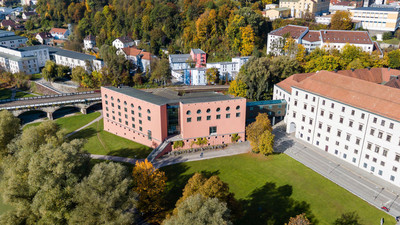
Passau is a beautiful city with 53,000 inhabitants, located at the confluence of the three rivers Donube, Inn and Ilz. On our website on housing options, you'll get an overview of where to live in Passau. There are public and private student halls as well as private accommodation options.
At the University of Passau, there a no tuition fees. However, students do pay a semester fee.
We provide an overview of the cost of living in Passau and funding options.
Please use the DAAD scholarship database for information on scholarships for international applicants.
If you come to Germany to study and live here, you will have to go through some bureaucratic and administrative steps along the way. Which pieces of paperwork you need depends on your nationality.
Please read our website on visa and residence permits to find out details.
If you did read all the FAQ and didn't found the answer to your question, you can contact us: